Vegan
wolf
Keep on
Hand / Vegan shopping list
Foods
to keep on hand for VEGANS
(or anyone else for that
matter)
|
|
Here I
have a list of basic foods
that you will almost always find
in any vegan/vegetarian cooks
home, and most, probably in
yours as well. They are common,
easily found items that are good
to keep on hand. A few items
might be new to you, yet are easy
to find and a staple in most
vegetarian/vegan kitchens.
You
don't have to go out and
buy special foods unless you
feel so inclined. As I mentioned
before the easiest way to
feed a vegan, or vegetarian for
that matter, is just to serve
them more of the regular "side
dishes" .... potatoes, rice,
vegetables, salad, etc..... It
would actually even be healthier
for everyone to give up the
"meat" and just have the "side
dishes"!
But when
keeping a vegan/vegetarian home,
or you want to make the feel more
at home with you..... most of
these items will be appreciated.
These are also the basic
ingredients found in my recipe
section. (I am not including
everything on the list.. items
like salt, pepper, flour, corn
starch etc... I would assume most
homes would have them.)
This ist is a good basic
list. There you will see
easily found basic foods, as I
said, just to keep on hand. You
can also find hundreds of vegan
ready prepared foods, canned,
frozen, boxed, etc... and other
options at health food stores,
etc... that anyone would love,
that I don't have listed as
basic...
I
don't say "vegan" before every
item, yet it is assumed that it
is. What I mean is... a lot
of these items can be found to
contain meat or animal products,
whether it is a spaghetti sauce,
margarine, or even vegetarian
sausage. Labels generally
need to be read, no matter
what the item is, to be sure it
does not contain a non-vegan
ingredient.
On the
"substitutions page"
I
have noted my personal
recomendations for brands to
buy.

What do vegans really eat?
Follow two of us on Twitter.
A single vegan with no time to
cook.
and a married vegan with a big
social life!
Links to recipes too!
SEARCH ANY WORD
Loading
|
|
"Nonviolence
leads to the
highest ethics,
which is the
goal of all
evolution.
Until we stop
harming all
other living
beings, we are
still
savages."
Thomas
A. Edison
(1847-1931)
|
|
|
|
|
"People
often say that
humans have
always eaten
animals, as if
this is a
justification
for continuing
the practice.
According to
this logic, we
should not try
to prevent
people from
murdering other
people, since
this has also
been done since
the earliest of
times."
Isaac
Bashevis
Singer
|
|
|
|
|
"Since
an animal's
natural life is
a gift from
God, it follows
that God's
right is
violated when
the natural
life of his
creatures is
perverted.
Those who, in
contrast, opt
for the
welfarist
approach to
intensive
farming are
inevitably
involved in
speculating how
far such and
such may or may
not suffer in
what are
plainly
unnatural
conditions. But
unless animals
are judged to
have some right
to their
natural life,
from what
standpoint can
we judge
abnormalities,
mutilations or
adjustments?
Confining a
de-beaked hen
in a battery
cage is more
than a moral
crime; it is a
living sign of
our failure to
recognize the
blessing of God
in
creation."
-Rev.
Dr. Andrew
Linzey from
Christianity
and the Rights
of Animals,
1988
|
|
|
|
A
few ITEMS to really watch out for
:
Besides
the obvious "milk", "butter",
"chicken broth"&.,
that find there way into many
products, common animal
ingredients include
"casein", "gelatin", "lard",
"lanolin", "rennet",
"whey"&
Margarine.. Most contain
whey
Pasta&. Some contain
egg.
Soy cheese sometimes has
dairy rennet.
Mayonnaise& most
contain
egg
Check
the NON-VEGAN
INGREDIENTS
for a more extensive
list.
|
Please, Consider Making
a Donation
|
|
Other
reasons and issues
to think
about
when purchasing any
product whether for
vegans or
not...
- That
it is organically
grown.
- Made
using the most
environmentally sound
agricultural methods
possible.
- That
employs fair labor
practices.
- Locally
grown has presidence
over items shipped
in.
- Avoid
packaged foods,
plastics, artificial
ingredients,
G.M.O.s...
- What
political
associations does
this food product
represent? Example:
Canada supporting the
seal hunt...
- etc...
A
lot of vegans consider
these factors heavily
too when buying
anything, so it, of
course, is always
appreciated to find
out what else is really
important to a vegan
or anyone else for that
matter, if you really
want to be considerate
of their
ideals.
|
|
Nutritional
Yeast
Fortified Yeast is
considered by many to be
the most valuable
supplement available. It
is a complete protein
and contains more
protein than meat. Yeast
is an excellent source
of B-vitamins including
B12 and it contains the
glucose tolerance factor
that helps in the
regulation of blood
sugar. It is a
single-celled fungi
present in the air
around us and on fruits
and grains - it converts
various types of sugar
to alcohol. The earliest
recorded use was in 1550
BC in Egypt.
Nutritional
yeast is grown on
mineral enriched
molasses. At the end of
the growth period, the
culture is pasteurized
to kill the yeast. You
never want to use a live
yeast (i.e. baking
yeast) as a food
supplement because the
live yeast continues to
grow in the intestine
and actually uses up the
vitamin B in the body
instead of replenishing
the supply. (Brewer's
yeast is nutritionally
the same but as a
by-product of the
beer-brewing industry it
has a characteristic
bitter hops
flavor.)
Nutritional
yeast contains 18 amino
acids (forming the
complete protein) and 15
minerals. Being rich in
the B-complex vitamins,
it is vital in many ways
and particularly good
for stress reduction.
The B-complex vitamins
help make nutritional
yeast such a valuable
supplement, especially
to the vegetarian. It is
one of the rare
vegetarian sources of
B12.
One
element of yeast is the
trace mineral chromium,
also known as the
Glucose Tolerance Factor
(GTF). This is necessary
to regulate blood sugar
and is important for
diabetics and people
with a tendency toward
low blood sugar.
RETURN
|

|
QUICK LIST
Easy
to find Food ITEMS to KEEP ON
HAND
This
of course is just a very
basic vegan list...
Agave
Nectar (Much like
Honey)
Bacos (or
other bacon like bits)
Balsamic
vinegar (great for a salad
dressing)
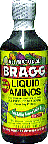
Braggs
Liquid Aminos (Made from
soybeans, a concentrated protein,
flavor enhancer, great for
salads, sauces, etc...found in
small bottles at health food
stores)
Bread.
Sandwich bread / French
Bread...
Canned or
dried Beans/ garbonzo, kidney,
black, red...
Canned
spaghetti sauce
Canned
vegetarian/vegan Baked beans and
refried beans
Canola
oil
Fruits:
Fresh / Dried
Garlic
Garlic
salt
Jam/
Jelly
Juices
Lemon
juice
Meat
analogs and alternatives:...
burger, tofurky, Seitan,
tempeh...
Mustard
Nutritional
Yeast (A
MAJOR product for vegans and
vegetarians. A nutty/cheesy
flavor Sprinkle on salads,
popcorn, casseroles, pizza,
sauces.... Makes into a great
vegan cheese
alternative!
Found in all health food stores,
bulk section)
(NOT BREWERS YEAST!)
(See side bar for more
information)
Nuts/seeds
Olive
Oil (For basic cooking and
salads)
Pasta
Peanut
Butter
Pickles
Popcorn
Ramin soup
(Nissin brand, oriental
flavor)
Rice
Salad
makings
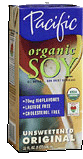
Soy
Milk (sweetened
for cereals and plain for sauces)
See side for more
information.
or other
Soy
Sauce
Spices
Spike or
Vegit type seasoned
salt
VEGAN
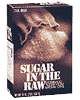
Sugar
(unrefined) Like "Sugar in
the Raw", Turbinado, or a brown
rice syrup, unbleached cane
sugar, etc....
Tahini
(sesame seed paste) Used to make
hummus, a great bread spread! or
just buy some
hummus....)
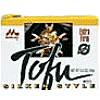
Tofu
Firm
and silken (See side for more
information)
Check out:
TOFU TIPS
Tomatos
Tortillas
Vegan bread
(Most authentic / old fashioned
French/Italian bread is vegan..)
(Avoid honey as an
ingredient.)
Vegan
Margarine
Vegetable
Broth powder
Vegetables:
Potatoes, Mushrooms, broccoli,
carrots, spinach, kale, etc&
Edamame
(soybeans)
Vegemite
or
Marmite:It’s
a food spread extracted from
brewers yeast that has a very
unique hard-to-describe flavor.
Frequently used as a topping on
bread or toast, it has a salty
taste that is quite strong, so –
“spread thinly”Also adds flavor to soups, and
gravies"
White
Vinegar
|






|
|
Soy
Milk
is
made by soaking
soybeans, cooking and
blending the soybeans,
and finally straining
off the soy
milk.
Soy
milk can be used for
drink, on cereal, and in
cooking.
There
are several
options for "milk"
substitutes, including
Soy Milk, Rice Milk,
Almond Milk, etc... Some
are sweetened and some
are plain, some are
chocolate, vanilla
etc... so personal
tastes and preferences
are the main key for
choosing a milk
alternative.
Don't
expect it to taste like
cows milk. It is a
product that can be
used in places
some people
traditionally use cows
milk, It is not made to
taste like
it.
If
you don't know which one
to choose, when
cooking use the
plain unsweetened, where
there is ONLY
soybeans and water on
the ingredients. Any
other ingredients, even
when it says unsweetend,
can alter the taste in
the final
product.
Nutritional
Value of
Soymilk
Plain,
unfortified soymilk is
an excellent source of
high-quality protein,
B-vitamins and iron.
Some brands of soymilk
are fortified with
vitamins and minerals
and are good sources of
calcium, vitamin D and
vitamin B-12. Soymilk is
free of the milk sugar
lactose and is a good
choice for people who
are lactose intolerant.
Also, it is a good
alternative for those
who are allergic to
cow's milk. Children can
enjoy homemade or
commercially prepared
soymilk after the age of
1 year. Infants under 1
year of age should be
fed breast milk,
commercially prepared
infant formula or
commercial soymilk
infant
formula.
RETURN
|

CONTACT
VEGAN WOLF
|
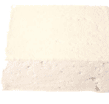
Tofu
also
known as soybean curd,
is a soft, cheese-like
food made by curdling
fresh hot soymilk with a
coagulant.
Traditionally, the
curdling agent used to
make tofu is nigari, a
compound found in
natural ocean water, or
calcium sulfate, a
naturally occurring
mineral. Curds also can
be produced by acidic
foods like lemon juice
or vinegar. The curds
then are generally
pressed into a solid
block.
In
recipes, tofu acts like
a sponge and has the
miraculous ability to
soak up any
flavor that is added
to it.
Types
of
Tofu
Three
main types of tofu are
available in American
grocery
stores.
Firm/
extra firm tofu is
dense and solid and
holds up well in stir
fry dishes, soups, or on
the grill... anywhere
that you want the tofu
to maintain its shape.
Firm tofu also is higher
in protein, fat and
calcium than other forms
of tofu. Usually found
in water, in a plastic
bag or carton in the
refrigerated
section.
Soft
tofu is a good
choice for recipes that
call for blended
tofu.
Silken
tofu is made by a
slightly different
process that results in
a creamy, custard-like
product. Silken tofu
works well in pureed or
blended dishes, or
beverages. Usually found
in aseptic
(cardboard-like)
packages on shelves.
TOFU TIP: For
Stir frying or baking
PRESS the firm extra
firm tofu before using.
Place tofu betweeen a
cotton cloth and put
something heavy on top
of it for an hour or
longer.
Another
TOFU TIP:
FREEZE tofu, then thaw
before cooking for a
slightly chewier
texture.
Tofu
Nutrition
Facts
Tofu
is rich in high-quality
protein. It is also a
good source of
B-vitamins and iron.
When the curdling agent
used to make tofu is
calcium salt, the tofu
is an excellent source
of calcium. While 50
percent of the calories
in tofu come from fat, a
4-ounce serving of tofu
contains just 6 grams of
fat. It is low in
saturated fat and
contains no cholesterol.
Generally, the softer
the tofu, the lower the
fat content. Tofu is
also very low in sodium,
making it a perfect food
for people on
sodium-restricted
diets.
RETURN
|
|
Edamame
A
"green vegetable" soy
bean, Served either in
the pod or shelled.
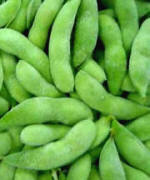
The
word edamame means
"Beans on
Branches'
The
pods are lightly boiled
in salted water then the
seeds are pushed
directly from the pods
into the mouth with the
fingers, or lightly
strained through the
teeth.
Very
much like eating Pea
Pods, but you don't eat
the shell.
RETURN
|
|
SUGAR
About
half of the sugar
produced is cane sugar,
the other half is beet
sugar. There is
virtually no difference
between them besides
originating from
different plants,
although cane sugar
is, in about half of
the processors, is
bleached using bone
char, charcoal made
form the bones of
animals.
There are many "sugars"
on the market. "Sugar in
the Raw", Turbinado, or
a brown rice syrup,
unbleached cane sugar,
etc....that can be
easily used in place of
regular sugar, and most
likely have a better
nutritional analysys,
and environmental
impact.
RETURN
|
|

|
|


|
|
|
